


Across South Asia, public space has historically been governed by an unspoken gender hierarchy. Streets, transport hubs, marketplaces, and city walls have largely functioned as masculine territories, while women, queer people, and marginalized communities often navigate these environments under surveillance, restriction, and fear. In response to these conditions, a powerful wave of feminist public art has emerged across the region. Through monumental murals painted on urban walls in India, Pakistan, Bangladesh, Nepal, and Afghanistan, artists and communities are transforming public landscapes into sites of resistance, memory, and collective visibility. Among the most influential initiatives within this movement is the Fearless Collective, a transnational network that uses collaborative mural-making to challenge patriarchal control over public space.
Origins in Protest and Public Grief
The collective was founded in 2012 by Indian artist and activist Shilo Shiv Suleman following the brutal Delhi gang rape case that became globally known through the symbolic name “Nirbhaya,” meaning “fearless.” The incident ignited mass protests throughout India and sparked intense public debate regarding women’s safety. Much of the official and media response, however, focused on surveillance, curfews, and restricting women’s movement in the name of protection. Women were repeatedly advised to stay indoors, avoid public spaces at night, and alter their behavior to prevent violence.
Suleman rejected this framework of fear-based protection. Instead, she argued that reclaiming public space required visibility rather than withdrawal. The Fearless Collective emerged from this conviction, proposing that streets become safer not when women disappear from them, but when women occupy them more fully and more visibly. What began as an online campaign inviting women and artists to replace fear with affirmations of desire, dignity, and freedom soon evolved into a large-scale movement grounded in public art and community participation.
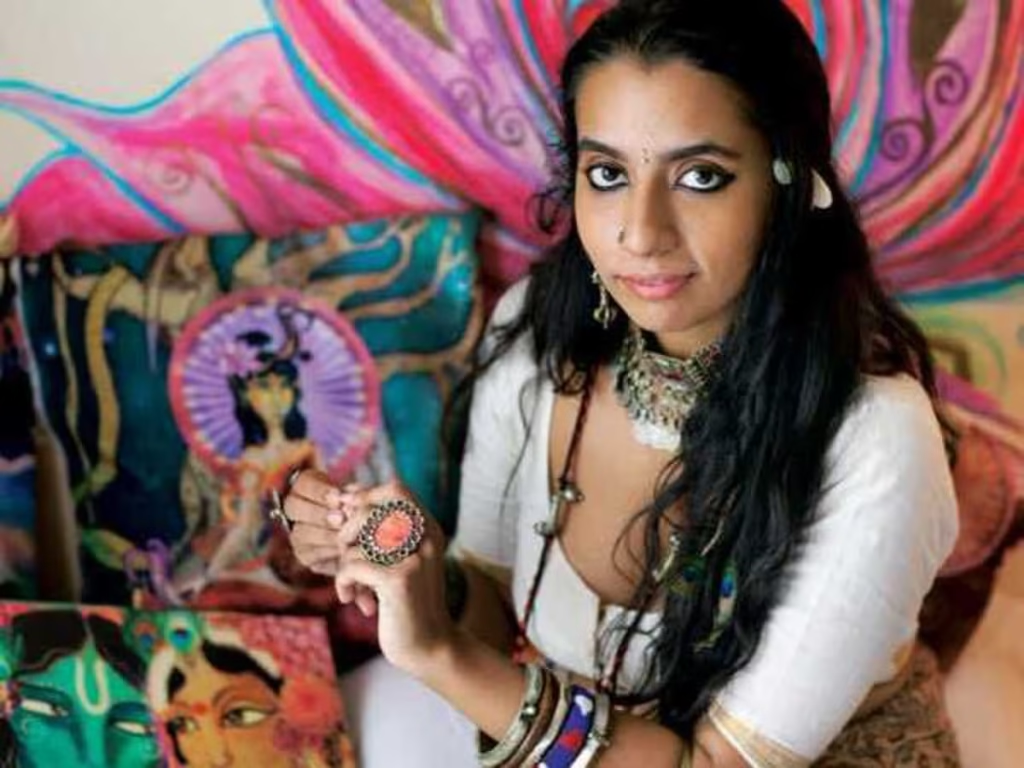
Over time, the collective expanded into a regional network involving hundreds of artists, activists, storytellers, and local residents across South Asia. Its projects seek not only to address violence against women but also to reimagine who has the right to occupy public space, speak publicly, and be represented on the walls of the city.
Participatory Art as Collective Healing
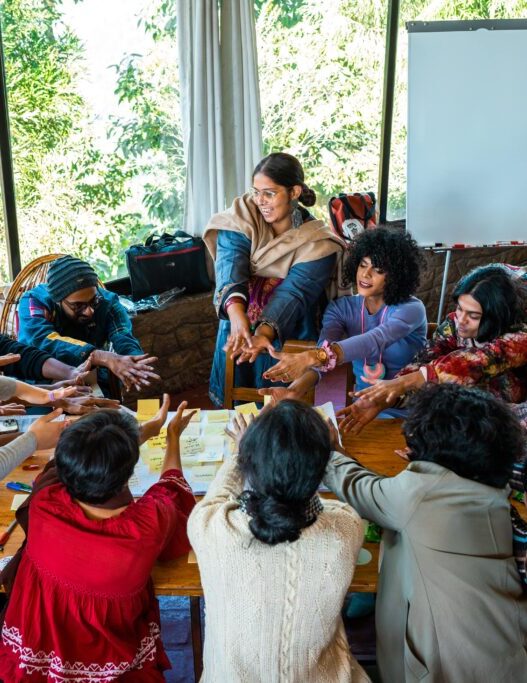
A defining feature of the Fearless Collective is its emphasis on collaboration rather than individual artistic authorship. The murals are not designed in isolation and then imposed onto communities. Instead, each project begins with extensive workshops involving local women, transgender participants, youth groups, laborers, and community organizers.
Within these workshops, participants discuss their experiences of moving through public environments, sharing stories about visibility, harassment, shame, resilience, and belonging. Conversations often explore the distinction between being objectified through hostile attention and being genuinely recognized as human. Rather than centering only trauma, the workshops encourage participants to imagine alternative futures grounded in healing, solidarity, and self-determination.
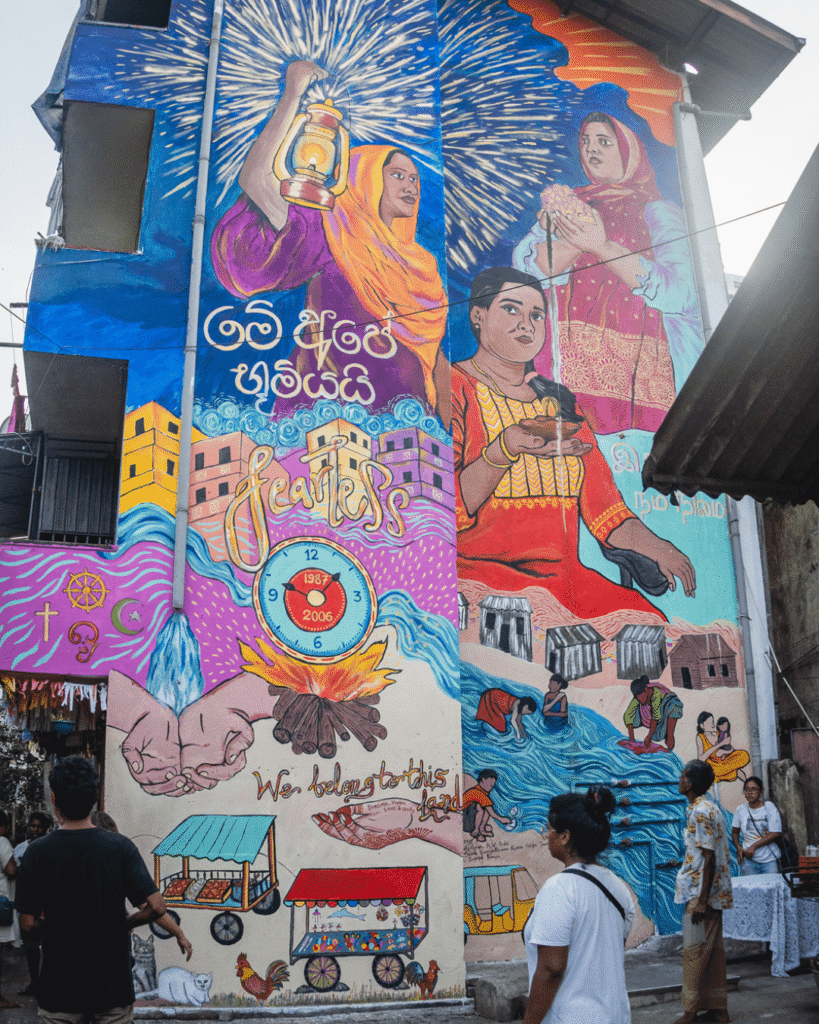
These discussions eventually generate phrases, symbols, and visual metaphors that become central to the final artwork. The resulting murals therefore function not merely as decorative images but as collective archives of lived experience. The wall becomes a shared surface where personal testimony is transformed into public memory.
Reclaiming Urban Landscapes Across Borders
The collective’s work extends across multiple South Asian countries, creating a regional visual language of feminist resistance that transcends national boundaries. Despite different political systems and cultural contexts, many of the themes addressed by the murals—gendered violence, social control, family honor, labor invisibility, and queer marginalization—resonate widely across the subcontinent.
India
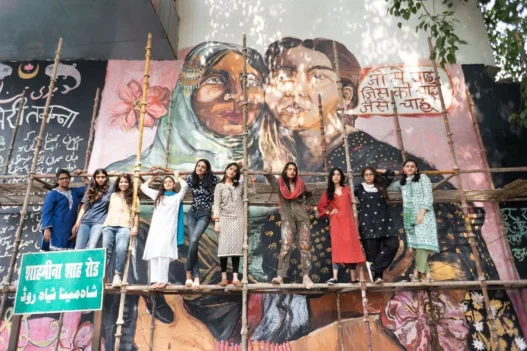
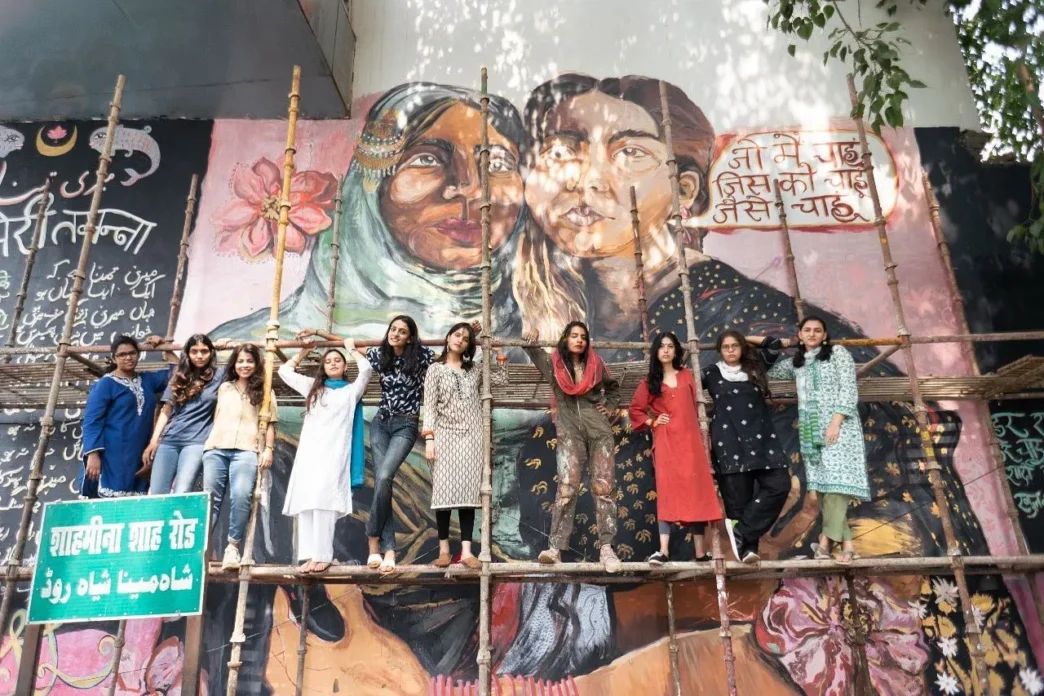
In India, murals created in cities such as Delhi and Bengaluru foreground women’s labor, protest movements, and community resilience. During the women-led resistance movement at Shaheen Bagh, large-scale public artworks celebrated Muslim women who occupied the streets in defense of democratic rights and constitutional equality. These murals transformed protest sites into visual declarations of collective presence, insisting that women belong not only in domestic spaces but also at the center of political life.
Pakistan
In Pakistan, the collective collaborated with local activists and transgender communities in cities including Karachi and Lahore. One of the most significant projects emerged in Rawalpindi through a collaboration with Wajood. Together, artists and activists created a mural portraying transgender activist Babli Malik riding a motorcycle surrounded by streams of flowers. Positioned near a male-dominated mechanics’ district, the mural asserted transgender visibility and dignity within a space traditionally hostile to gender nonconformity. The Urdu phrase incorporated into the work, “Hum hain khuda-e-takhleeq” (“I am a creation of God”), framed trans existence as sacred rather than deviant.
Bangladesh, Nepal, and Afghanistan
Projects in Bangladesh, Nepal, and Afghanistan have addressed issues ranging from climate displacement and labor exploitation to migration and political instability. Through artist residencies and regional mentorship programs, the collective has supported emerging local women artists while adapting each mural to local histories and struggles. In many of these works, women are depicted at monumental scale, gazing directly outward rather than appearing passive or ornamental. Their visual presence interrupts conventional portrayals of femininity and replaces submissive representation with agency and confrontation.
Challenging the Gender Politics of Muralism
Large-scale mural painting has historically been dominated by men, partly because of the physical demands associated with climbing scaffolding, working at dangerous heights, and occupying public streets late into the night. By placing women and queer artists at the center of this process, the Fearless Collective disrupts longstanding assumptions about who can physically shape the urban environment.
This transformation can be understood through several major shifts in the politics of mural-making.
From Marginal Graffiti to Civic Monument
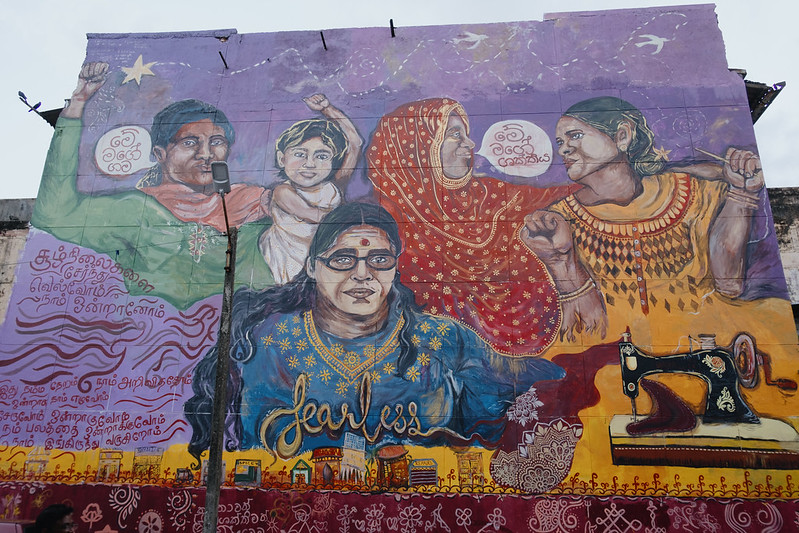
Unlike unsanctioned graffiti that often exists at the margins of legality, these murals frequently operate as community-endorsed public monuments. Painted across multi-story buildings, they command visibility within the cityscape and force feminist narratives into spaces typically reserved for state power, commercial advertising, or nationalist symbolism.
Reframing the Public Gaze
Historically, public monuments across South Asia have celebrated military leaders, political elites, or idealized representations of femininity. In contrast, the murals of the Fearless Collective foreground ordinary women, laborers, transgender people, and community organizers. Bodies that have historically been hidden, stigmatized, or sexualized are reintroduced into public view with dignity and authority. The murals replace objectification with what many scholars describe as a feminist gaze: an approach that recognizes marginalized people as subjects with agency rather than passive objects of observation.
Collective Creation Over Artistic Individualism
The collective also challenges the myth of the solitary artistic genius. Instead of prioritizing individual authorship, the projects emphasize communal production. Local residents contribute stories, slogans, and symbolic imagery, making the murals products of shared imagination rather than singular artistic ownership. This collaborative structure mirrors the political goals of the movement itself, emphasizing solidarity over hierarchy.
From Streets to Institutional Spaces
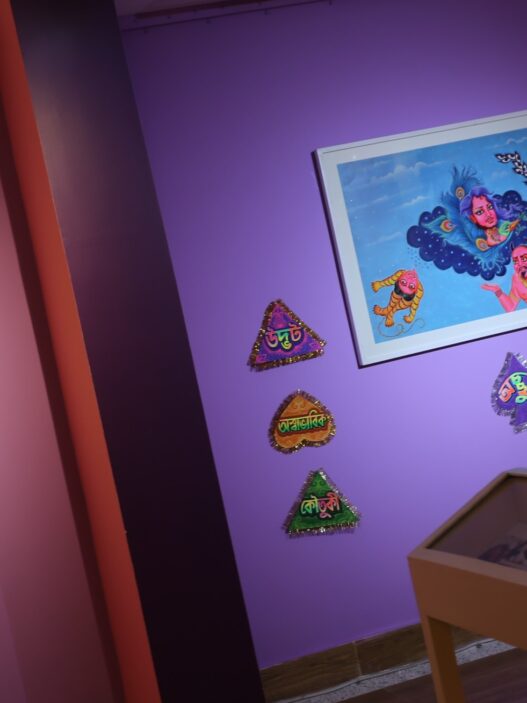
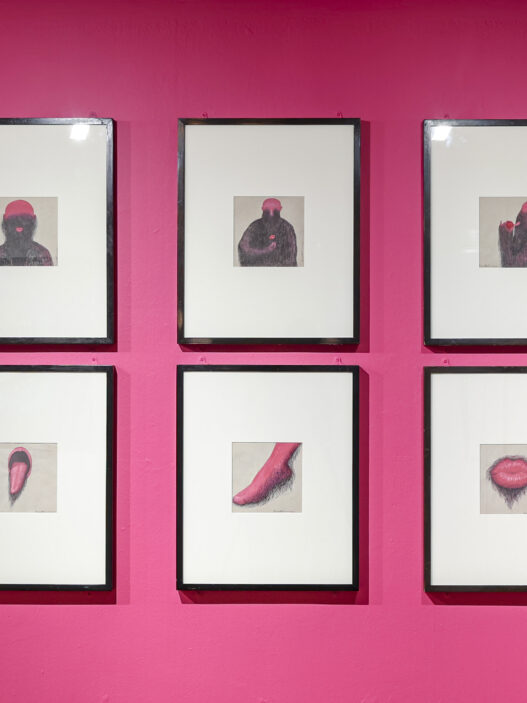
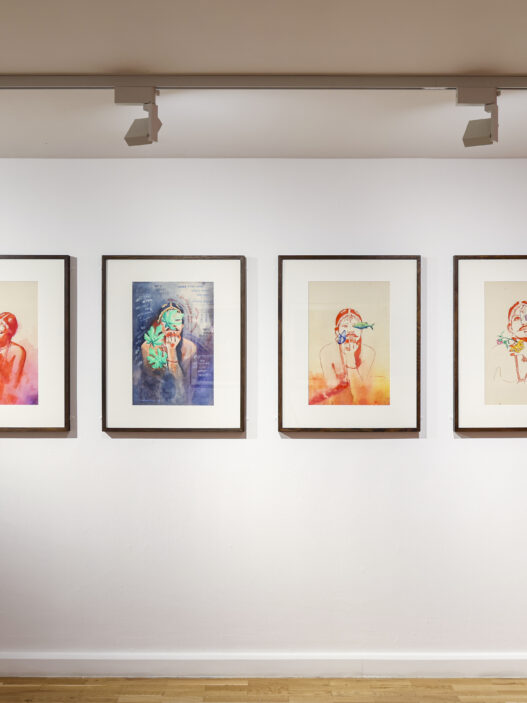
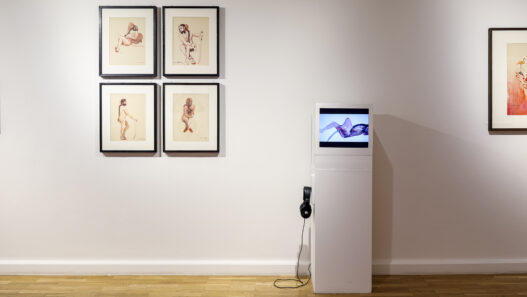
Although the collective’s primary medium remains the street mural, its work has increasingly entered museums, galleries, and international policy forums. One major development in this transition was the exhibition Art of Liberation, curated in collaboration with curator Myna Mukherjee. The exhibition assembled works and archival materials from artists across India, Pakistan, Nepal, Bangladesh, Afghanistan, Sri Lanka, Myanmar, and Iran.
Rather than presenting protest art as temporary or disposable, the exhibition reframed these practices as historically significant forms of cultural production. Installations incorporated posters, photographs, murals, and immersive architectural elements that echoed the circular structure of yogini temples, connecting feminist resistance with spiritual and historical traditions from South Asia.
Among the featured works was Suleman’s Women of Shaheen Bagh Standing Guard over India’s Democracy, which portrayed a monumental female figure protecting the nation through slogans such as “Fearless” and “Hum yahin ke hain” (“We are from here”). Another installation revisited one of Suleman’s earliest public interventions: a life-sized figure placed at a Delhi bus stop after the 2012 assault case, covered with testimonies and texts relating to gendered violence. Within the gallery context, the piece functioned both as memorial and historical document, linking contemporary feminist art to a broader archive of public resistance.
Public Art and the Transformation of Space
The significance of the Fearless Collective lies not only in the aesthetic impact of its murals but also in its transformation of public psychology. By placing women and marginalized communities at monumental scale across city walls, the collective challenges deeply rooted systems of patriarchy, caste exclusion, religious nationalism, and gender policing.
The murals operate through visual accessibility, making political messages available even in contexts where literacy barriers may limit access to written activism. Their imagery bypasses institutional language and communicates directly through color, scale, gesture, and emotion. In this sense, public art becomes a democratic medium capable of reaching audiences beyond elite cultural spaces.
More importantly, the process of painting itself becomes political performance. Women standing on scaffolding, occupying streets with brushes and paint, enact a visible refusal of confinement. The murals therefore function on two levels simultaneously: as finished visual statements and as records of collective occupation.
Conclusion
The feminist mural movement led by the Fearless Collective demonstrates how public art can reshape both physical and symbolic landscapes. Through collaborative storytelling, monumental imagery, and transnational solidarity, the collective has transformed city walls into platforms for marginalized voices across South Asia.
These murals do more than beautify urban environments. They contest who belongs in public space, who has the right to visibility, and whose stories deserve permanence within the social imagination. Whether painted in crowded alleyways, protest sites, or gallery halls, the works insist that fearlessness is not an abstract ideal but a public practice—one written directly onto the walls of the city.
Bibliography
Articles, Interviews, and Reports on the Fearless Collective
Association for Women's Rights in Development (AWID)

Conference archives and feminist art presentations featuring the Fearless Collective.

URL: https://www.awid.org/

Fearless Collective

Official Website. Home to project archives, regional residency overviews, and global mural map data.

URL: https://fearlesscollective.org/

“Murals Against Fear: The Feminist Street Art of South Asia.”

Scroll.in, Culture & Arts Section. An exploration of the collective's cross-border interventions in Pakistan and Bangladesh.

“Painting Resistance: Fearless Collective Across Borders.”

The Indian Express, Expression Section. Feature on the physical and logistical feats of women painting high-rise urban walls.

“Public Art and Feminist Protest in Contemporary India.”

Journal of South Asian Cultural Studies, vol. 14, no. 2, pp. 45–62. Academic analysis of how participatory public art shifts the community gaze.

Suleman, Shilo Shiv

Official Website. Portfolio of individual multimedia works, illustrations, and curatorial projects.

URL: https://www.shiloshivsuleman.com/
“Fearless: Art as Resistance in Public Space.” Lecture presented at global feminist and peace forums including AWID and the United Nations Institute of Peace.

United Nations Institute of Peace (USIP)

Reports and public discussions on art, conflict transformation, and community peacebuilding.

URL: https://www.usip.org/

“Women Reclaiming Public Spaces Through Art.”

The Hindu, Arts and Culture Section. Review of Fearless Collective's early interactive street interventions in major Indian metros.

Sources Related to Shaheen Bagh and Feminist Protest
Ghosh, Shohini

“Women of Shaheen Bagh and the Reinvention of Protest.” Feminist Studies Journal, vol. 46, no. 3, pp. 512–534. Examines the spatial and visual politics of the women-led citizenship protests.

Kaul, Nitasha

“Citizenship, Gender, and Resistance in Contemporary India.” South Asia Multidisciplinary Academic Journal (SAMAJ), free-access digital edition.

Sources on Transgender Rights and Public Space in Pakistan
“Queer Publics and Urban Resistance in South Asia.”

Journal of Gender Studies, vol. 29, no. 4, pp. 381–396. Research on how marginalized gender identities claim visibility in strictly gendered urban areas.

“Transgender Visibility Through Street Art in Pakistan.”

Dawn News, Features Division. Multimedia report covering the collaborative mural project with activist Babli Malik and the trans-led organization Wajood.

Exhibition and Curatorial References
Mukherjee, Myna, curator

Art of Liberation. Exhibition catalogues and curatorial essays featuring contemporary and street artists from India, Pakistan, Bangladesh, Nepal, Afghanistan, Sri Lanka, Myanmar, and Iran. Engagewith-art initiatives.